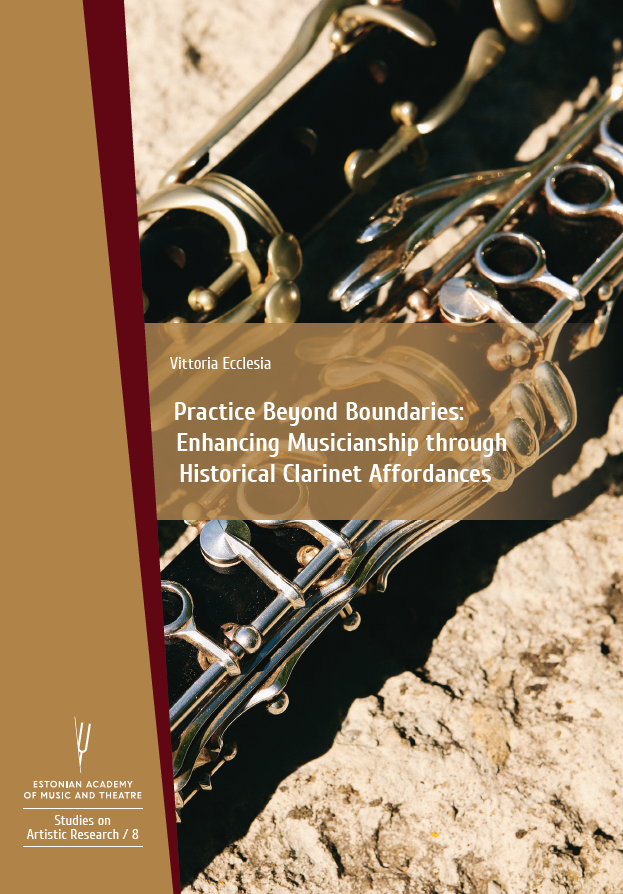
The author explores how practice and performance on modern clarinet are affected by the exploration of musical affordances on historical clarinet. The historical clarinet considered is a 13-keyed instrument, developed by the clarinettist and composer Iwan Müller at the beginning of the 19th century. Müller’s clarinet is not used as a historical instrument. It is taken into a modern context, and explored in practice sessions alongside its modern relative.
The process led to the identification of five main thematic areas encompassing different musical affordances of historical clarinet: technique, air and sound production, articulation, intonation, and interpretation and phrasing. In each area, the historical clarinet afforded different actions than the modern one, showing its potential as an individual instrument. The results showed how musical affordances could be applied in everyday practice, and how they influenced modern clarinet practice not only in its technical aspects but also more abstractly, in the mindset and approach to music.
In English. Summary in Estonian (Piire ületav harjutamine: muusikalise meisterlikkuse arendamine ajaloolise klarneti pakutavate võimaluste kaudu)
Online-version of the book available here
Eesti Muusika- ja Teatriakadeemia Loovuurimused 8 / Estonian Academy of Music and Theatre. Studies on Artistic Research 8
Estonian Academy of Music and Theatre Press, 2026, ISBN 978-9908-9730-2-9